Technology2026-09-195 min read

UAE AI Agents for Small Businesses: Automate Work Safely

AI agents are moving beyond drafting text and towards multistep work. Here is what UAE owners can sensibly automate, what must stay human, and how to test it safely.

UAE AI Agents for Small Businesses: Automate Work Safely

AI agents vs assistants: what they do for business

TechCrunch’s 16 September 2026 article is a preview of a TechCrunch Disrupt session called “Hiring When AI Is a Co-Founder”. Its central point is practical: AI agents are beginning to handle engineering, customer support, research and operational work that might once have been given to early employees.

The important distinction is between an assistant and an agent. An assistant helps a person complete a task. An agent can be given a goal and carry out several steps. That may include researching information, preparing an output, moving data between systems or starting a workflow. The human still needs to decide what the agent may access, what it may do and who checks the result.

The useful question is not “Which job can AI replace?” It is “Which repeatable work can an agent handle without owning the final decision?”

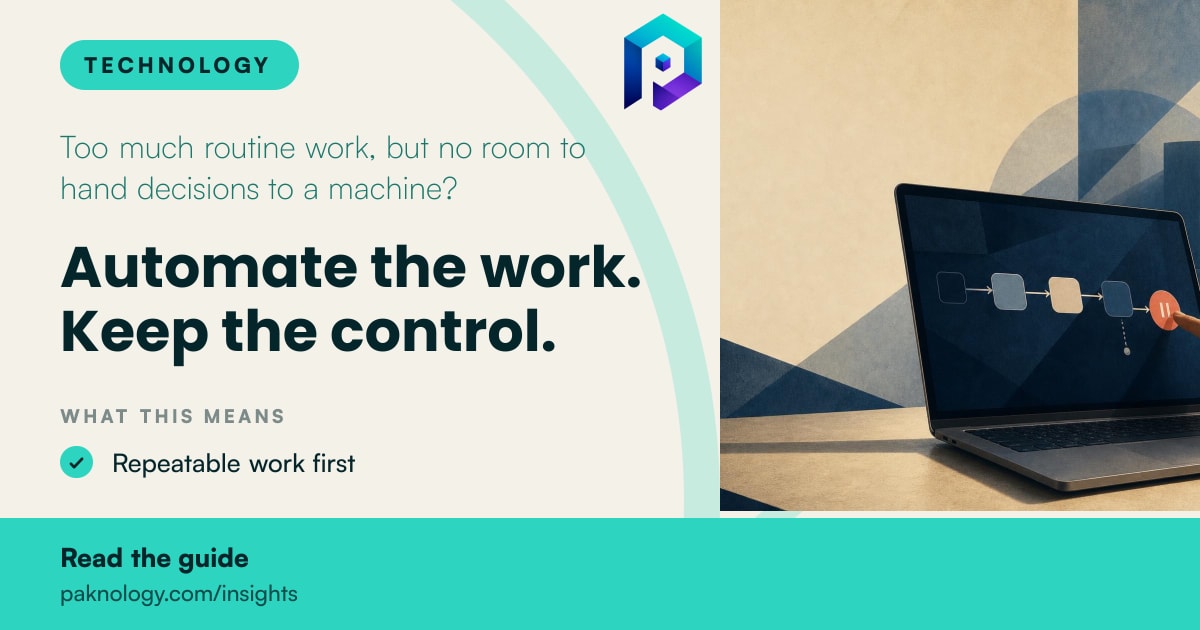
A human hand hovers over an approval switch as flowing data passes through it toward a tablet.
A human hand controls a glowing switch while organised light trails flow through a dark data landscape.

AI agents for UAE small businesses: what changes

For a small UAE company, this shifts the conversation from hiring titles to business processes. A founder may not need to think first about hiring another administrator, support agent or junior researcher. They can first map the work those roles would perform and identify which parts are repetitive, rules-based and easy to review.

That does not mean removing people from the process. TechCrunch’s article stresses that humans remain responsible for understanding customers, challenging poor strategy, making decisions and taking responsibility when something goes wrong. Those responsibilities matter in the UAE just as they do elsewhere, particularly when an agent touches customer records, pricing, finance, employee information or public claims.

A sensible owner keeps human approval over refunds, pricing changes, contracts, hiring decisions, supplier payments, advertising spend and anything that could create a legal, financial or reputational obligation. An agent can prepare the work. It should not quietly become the person accountable for it.

AI agent example for a UAE online seller

Consider a UAE online seller with product information in one system, customer questions arriving through WhatsApp and orders coming through marketplaces. A controlled agent could gather approved product information, draft answers to common questions, flag incomplete orders and prepare a daily list of stock or customer-service issues.

The owner or a named employee would still approve replies involving complaints, refunds, delivery disputes or product claims. The agent would not be given unrestricted authority to change prices, issue credits or spend on advertising. Its role would be to reduce the manual checking and copying between systems, not to make commercial decisions.

This is an example of where the value is likely to sit: fewer hand-offs, faster first drafts and a clearer queue of work. It is not proof that every business needs a general-purpose agent. If the underlying records are incomplete or spread across disconnected spreadsheets, automation may simply make errors travel faster.

How to test AI agents safely in the UAE

Start with one workflow that has a clear beginning, end and owner. Do not begin with “automate customer service”. Begin with something narrower, such as “prepare replies to delivery-status questions using approved information”.

Keep a simple register showing each agent, its purpose, connected systems, permitted actions and human owner. This is especially important if the agent can reach email, customer records, shared drives, accounting tools or ecommerce systems. Paknology’s ERP and automation service describes a similar principle for wider business systems: map the process first, then define modules, roles, workflows and reports before configuration.

  • —Write down the exact task and the acceptable output
  • —Give the agent only the data and tools it needs
  • —Keep sending, spending and record-changing actions behind approval
  • —Check a sample of completed work against a human result
  • —Stop if checking takes longer than doing the task manually

When rule-based automation, CRM or ERP is better

An AI agent is not automatically the right answer. A small firm with one reliable workflow may be better served by a rule-based automation, a proper CRM, a shared inbox or an ERP module. Those systems are often easier to audit because the permissions and steps are explicit.

The same applies to a new business. It may need a company licence, a functioning website or marketplace onboarding before it needs an agent. A business that still lacks a single view of stock, sales and receivables should fix that foundation first. Paknology’s own guide on AI-agent security for UAE firms makes the same broader point: know which tools exist, what they can reach and who approves their access.

If a business is already reviewing connected operations, the implementation should be staged. Paknology says a focused CRM and billing rollout can take 6–10 weeks, while broader ERP work with inventory, HR and integrations typically runs in phases over 8–14 weeks. Those are its stated delivery ranges, not a universal timetable.

When Paknology’s ERP and workflow automation fit

Paknology has a commercial interest where this decision leads to ERP and workflow automation work. It provides UAE company formation and trade licences, ecommerce launches, websites and mobile apps, ERP and automation through ZamBooks, restaurant POS, digital marketing and SEO, and WhatsApp Business API through Waphie. It does not provide a general licence to hand every business decision to an autonomous AI system.

A cheaper or simpler option may be better if the task can be handled with an existing feature in your accounting, ecommerce, CRM or messaging software. A specialist technology or security provider may be more suitable if you need advanced monitoring across many agents and sensitive systems.

Choose one repeatable workflow, document the approvals and measure time saved against checking time. If the gap is connected business processes rather than a standalone experiment, review ERP and automation and start with a defined scope.

Ready to launch, automate and scale?

Book a free consultation and get a clear roadmap — from company formation to a fully automated digital operation.