Technology2026-11-084 min read

Amazon’s 34 New Devices: A UAE Seller Planning Guide

Amazon says early demand is strong for 34 new devices across Echo, Kindle, Fire TV, Ring, Blink, Bee and Alexa Tablets. UAE sellers should treat this as a range-planning signal, not proof of a local launch.

Amazon’s 34 New Devices: A UAE Seller Planning Guide

Amazon’s 34 New Devices Span Seven Product Families

Amazon reported strong early demand for 34 new devices across Echo, Kindle, Amazon Alexa Tablets, Fire TV, Ring, Blink and Bee. It also said Alexa+ has expanded to Australia, India and Japan, while compatible Fire TV customers in the United States can use Alexa+ at no charge. The announcement appeared in Amazon’s third-quarter results for the period ended 30 September 2026. Read Amazon’s Q3 results release.

That matters because this is an ecosystem push, not one isolated product launch. More device types can mean more demand for accessories, installation, support, connectivity and compatible smart-home products. But the release does not announce UAE availability for the new devices or Alexa+.

The useful signal for a UAE business is the breadth of the ecosystem, not a promise that every device is coming to Amazon.ae.

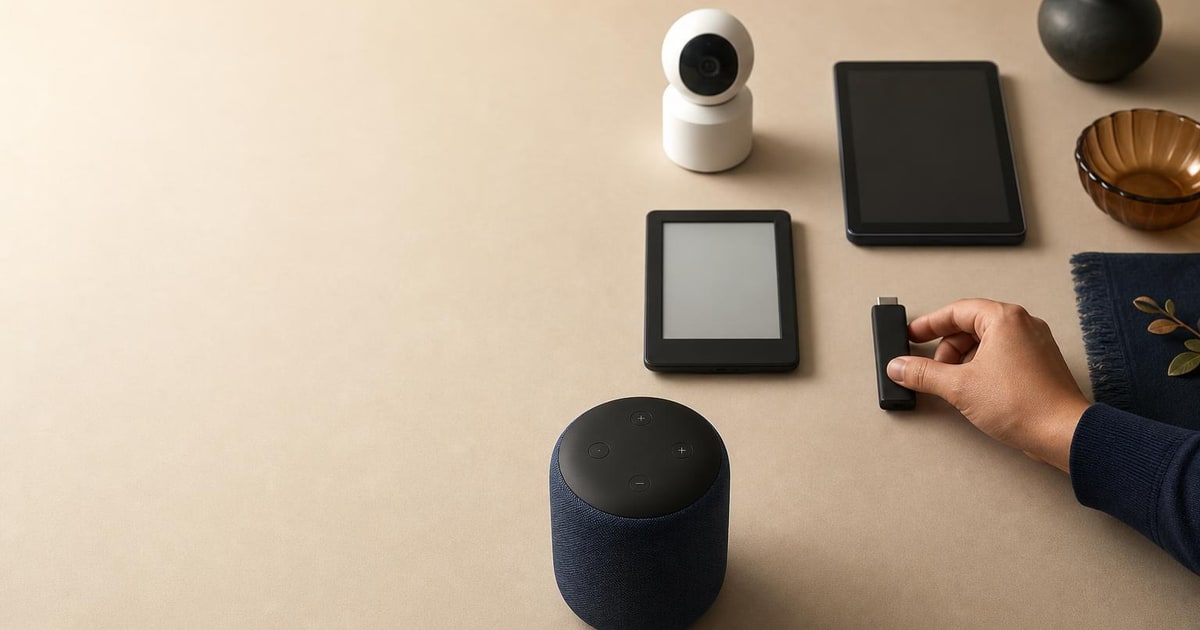
A hand arranges several unbranded consumer devices in a neat planning grid on a seller’s table.

UAE Retailer and Distributor Checks Before Stocking

The immediate change is not that every electronics business needs new stock. It is that Amazon is giving more weight to connected devices and conversational shopping. In the same release, Amazon said Alexa for Shopping had been used by more than 400 million customers in the previous 12 months, with interactions up 570% year on year. That figure is global and relates to Alexa for Shopping, not confirmed UAE demand for the new hardware.

For a UAE retailer, the practical question is whether its products can sit around the ecosystem. That might include cases, mounts, cables, power accessories, home-network equipment, smart switches or security-related products. A distributor should also check whether a device is officially intended for the UAE, whether its wireless features are suitable for the local market, and who will handle warranty and returns. These are checks to make before committing stock, not reasons to assume a market exists.

Amazon also said independent sellers can use Seller Assistant workflows for routine tasks such as restocking and pricing. It added that sellers can manage listings, orders and profitability across multiple channels from Seller Central. That could make a small catalogue easier to operate, but it does not remove the need for accurate stock records or margin checks.
How a Dubai Electronics Shop Can Test Accessory Demand

Suppose a Dubai electronics shop already sells home-network products and wants to test demand around the new device family. The sensible first move is not to buy a large shipment of unconfirmed hardware. It is to choose one narrow product group, such as compatible mounting or power accessories, then check four things:

The shop can then create separate stock codes for each model and accessory, publish a small test range, and review sales, returns and customer questions after a defined trading period. If demand is weak, it has learned cheaply. If customers repeatedly ask for a device that is not available locally, that is evidence for a distributor conversation, not proof that a bulk order will work.

Businesses starting or expanding marketplace sales can use Paknology’s Amazon.ae and Noon ecommerce launch support. The important point is to treat the new range as a product-research exercise. Do not confuse Amazon’s global demand figures with a UAE sales forecast.

  • —Whether the product can be legally imported and sold
  • —Whether the listing is permitted on the chosen marketplace
  • —Whether local warranty support is clear
  • —Whether the margin survives delivery and returns

UAE Distributor Signals to Watch Before Ordering

The next useful signals are concrete ones: product pages for the UAE, local launch announcements, authorised distribution arrangements, compatible power specifications, support terms and marketplace search demand. Until those appear, a distributor can prepare without ordering.

Preparation could mean mapping existing smart-home customers, asking suppliers about regional versions, checking whether current inventory works with the relevant platforms, and estimating how much after-sales support each category would require. A company already selling through several channels should also make sure its stock and profitability records agree before adding fast-moving accessories. Paknology’s ERP and automation service is relevant where catalogue, stock and order data are becoming difficult to reconcile.

Amazon’s release gives sellers one strong number to remember: 34 new devices across seven named product families. It does not give a UAE launch date, local price, expected allocation or marketplace ranking. That is why the sensible response differs by business. A specialist distributor can investigate supply and compliance. A general retailer can monitor demand. A business with no connected-device customer base may sensibly do nothing.

UAE Ecommerce Setup Options for a Small Marketplace Test

Paknology has a commercial interest if this leads to ecommerce onboarding, product research, website work or ERP and automation. Our Business Setup & Ecommerce service is relevant to a UAE company preparing to sell through marketplaces, but a cheaper marketplace-only setup or a simple spreadsheet may serve a small test better. The next step is to confirm local availability, supplier terms and product eligibility before paying for stock or a larger operating system.

Ready to launch, automate and scale?

Book a free consultation and get a clear roadmap — from company formation to a fully automated digital operation.