ASUS RTX Spark laptops: local AI for UAE teams
ASUS has opened pre-orders for ProArt P16 and P14 laptops with up to 128GB of unified memory. Here is what that means for UAE agencies and developers considering private, on-device AI.

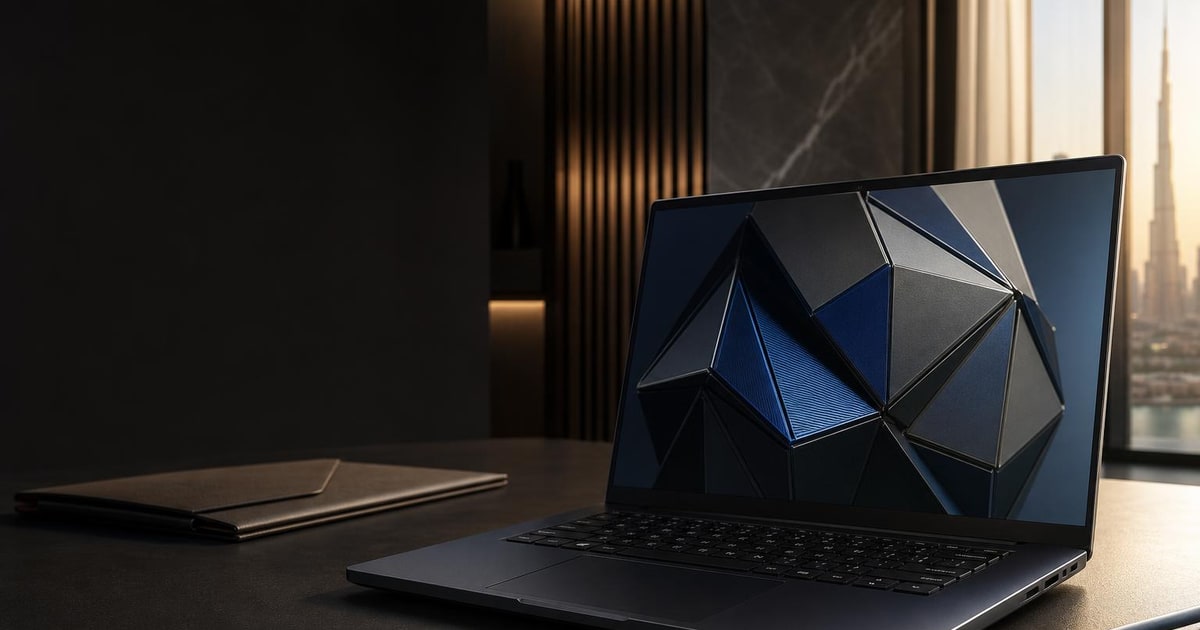
ASUS has opened global pre-orders for its ProArt P16 and P14 laptops powered by the NVIDIA RTX Spark Superchip. The useful part for a UAE agency or development team is not the branding. It is the combination of up to 128GB of unified memory, up to one petaflop of AI performance and local access to creative and agent workflows without a per-token charge.
The announcement is dated October 7, 2026, and ASUS says the laptops are available for pre-order through its US store, Best Buy and selected retailers. It does not confirm UAE stock, local warranty terms or local delivery. That distinction matters. A UAE business should treat this as a hardware signal and a possible procurement lead, not as proof that a local purchase route is already available.
The practical question is whether your team has enough repeat AI work to justify owning the capacity.

ASUS describes RTX Spark as a tightly integrated platform combining a Blackwell RTX GPU, a Grace CPU, fifth-generation Tensor Cores with FP4 support and NVLink-C2C technology. The ProArt laptops are designed to move between local AI, creative production, software development and other demanding workloads.
For a business, the headline specification is memory. Both the P16 and P14 can be configured with up to 128GB of on-board LPDDR5X memory. ASUS says that, depending on the model, quantisation, context length and available system memory, users can work with larger language and vision-language models, image and video generation pipelines, LoRA customisation and agentic workflows directly on the laptop.
That does not mean every 128GB model will run every large model well. It means the memory ceiling is materially higher than a typical creator laptop, and that more of the workflow can stay on the device. ASUS also says users can keep prompts, source files, project data and selected models on-device, with workflows that can remain available offline.
Consider a Dubai design agency producing campaign concepts, product images and short video variations for several clients. Its current process may send prompts, reference material and repeated generations to cloud services. The agency then manages usage controls, account permissions and the risk of placing client material into an external workflow.
A ProArt P16 with 128GB of memory could be used for local image and video workflows through ASUS MuseTree, FLUX, Wan and ComfyUI. An agent such as Hermes can connect with local files and creative tools, while the team keeps selected work on the machine. The benefit is not that cloud services disappear. ASUS explicitly says cloud remains useful for frontier-scale models and burst capacity. The benefit is that routine drafts, private material and repeated experiments can be handled locally when the model and workflow fit the hardware.
ASUS gives an illustrative estimate that, for demanding daily agent workloads, ongoing cloud token costs may exceed the cost of a ProArt RTX Spark PC within five to ten months. That is an ASUS estimate, not a UAE cost forecast. It depends on model choice, usage, caching, electricity, purchase cost and staff time. An owner should therefore test the team’s real workload rather than copy the estimate into a budget.
Start with an inventory of the work you actually want to move on-device. List the models, file types, average project size, number of daily runs and the material that cannot leave the business. Separate repeatable production work from occasional research. The first category is the stronger case for local hardware.
Then test compatibility. Ask whether your preferred models and tools support the operating system, NVIDIA CUDA environment and available memory. Check whether the workflow needs a 128GB configuration or whether a smaller system is enough. The P16 reaches up to a 4K OLED display and weighs 3.9 pounds. The P14 reaches up to a 3K OLED display and weighs 3.26 pounds. That makes them mobile creator systems, but portability is not the same as suitability for continuous team-wide model serving.
Finally, set a hybrid rule. Keep sensitive, repetitive or latency-sensitive work local where it performs well. Use cloud services for larger models, unusual jobs and demand spikes. If the project touches customer records, internal accounts or regulated information, your technology and data-handling policies still matter. A private laptop is not a substitute for access controls, backups or staff training.
If the local workflow must connect to stock, finance, sales or customer operations, map that integration before buying hardware. A business considering that broader workflow can review ERP and automation services and the practical requirements in our guide to affordable ERP for a small UAE retail business.
The strongest reason to do nothing is low utilisation. If your team generates a few images a week, uses AI mainly for drafting and already has a workable cloud process, a specialist local laptop may create another device to manage without removing much recurring spend. Cloud services also retain an advantage for frontier-scale models and burst capacity, according to ASUS.
The other issue is availability. The announcement covers global pre-orders but does not establish UAE pricing, stock, delivery dates or after-sales support. A UAE buyer should not commit based on a US listing alone. Ask a local supplier for the exact configuration, warranty coverage, keyboard layout, power arrangement and delivery terms, then compare that with the cost of keeping the current cloud workflow.
If your agency or development team runs AI-heavy creative work every day, document one representative workflow and test it against a local RTX Spark configuration when UAE supply is confirmed. If AI is occasional, keep the simpler setup and revisit the decision when your usage or privacy requirements change.
Paknology has a commercial interest where this becomes an ERP or automation project, because that is one of our services. We do not sell ASUS laptops or claim that every business needs one. A cheaper or simpler cloud workflow, or existing hardware with better process controls, will be the better choice for many firms. If local AI needs to connect to business systems, talk to us about the workflow rather than starting with the device.
Book a free consultation and get a clear roadmap — from company formation to a fully automated digital operation.