News2026-10-135 min read

UAE SVF Licence: What Checkout.com’s Approval Means

Checkout.com’s in-principle UAE approval could link payment acquiring, card issuing and business accounts. Here is what that means for UAE merchants, platforms and smaller firms.

UAE SVF Licence: What Checkout.com’s Approval Means

What Checkout.com’s UAE SVF approval means for merchants

Checkout.com has received in-principle approval from the Central Bank of the UAE for a Stored Value Facilities, or SVF, licence. If it completes the remaining requirements and receives the final licence, it plans to add card issuing to its existing UAE acquiring service on one platform.

That could matter to marketplaces, large retailers, travel firms and platforms that take payments and also need to issue cards to customers, suppliers, staff or partners. It does not mean every UAE business needs to change its payment provider. For most smaller firms, this is an infrastructure development to watch rather than an immediate task. Checkout.com’s announcement says the approval is intended to bring acquiring and issuing together, with business-account capabilities connected to the same platform. (checkout.com)

The important change is not simply a new card product. It is the potential link between money coming in and money going out.

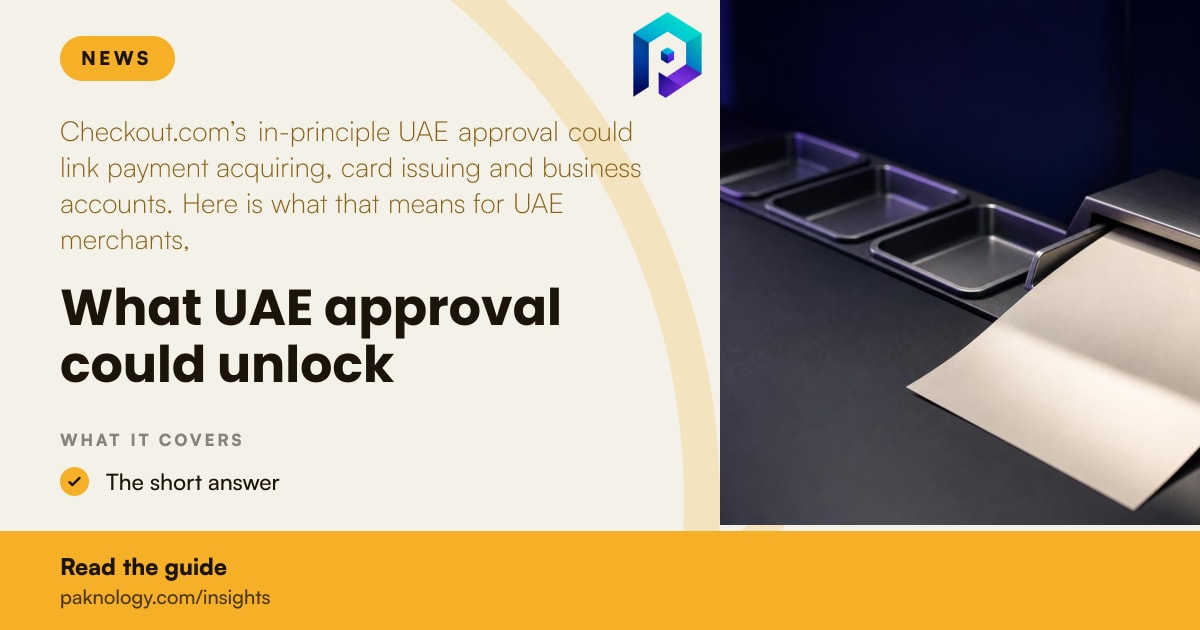
A blank regulatory licence is poised to be stamped on a dark counter beside a payment terminal.

What a UAE Stored Value Facilities licence covers

The CBUAE describes stored value as a facility where a customer, or someone acting for that customer, pays money or another form of value to an issuer in exchange for storing that value and using it under the facility’s terms. The framework covers device-based and non-device-based facilities.

Issuing or operating an SVF in the UAE requires prior CBUAE licensing, except for limited single-purpose arrangements. The regulation also gives the CBUAE power to set conditions, including controls on customer funds, business activities and the maximum value stored. The CBUAE licensing page lists SVF as a regulated category and separately identifies payment instrument issuance and merchant acquiring as retail payment services. (centralbank.ae)

The phrase “in-principle approval” matters. It is not the same as final authorisation. The CBUAE says an applicant must complete further requirements before the final licence is issued, and a regulated activity cannot be practised before that licence is obtained. Checkout.com’s own announcement also says the issuing capability will come once operational, not immediately.

How Checkout.com’s UAE SVF approval affects businesses

For a merchant using only online checkout, probably very little changes today. You still need to assess approval rates, settlement timing, fraud controls, integration work, reconciliation and commercial terms. The announcement does not publish a UAE price card, launch date or promise that every merchant will receive access to issuing.

The larger opportunity is for businesses with several money flows. Consider a UAE marketplace that collects AED 500,000 in customer payments during a month and wants to issue cards for seller payouts, refunds, employee spending or promotional credits. Today, it may need one provider for acquiring, another issuing partner and a separate process to move money between them. A connected model could allow eligible card programmes to draw from acquired balances, reducing the need to pre-fund those programmes. That is the practical point Checkout.com highlights.

The benefit is operational, not automatic financial saving. A business would still need to understand settlement rules, safeguarding, eligibility, reconciliation, chargebacks, card controls, compliance duties and the commercial structure offered to it.

  • —Most relevant: marketplaces, platforms and high-volume merchants
  • —Less relevant: a small shop taking ordinary card payments
  • —Still unconfirmed: launch timing, final licence conditions and merchant pricing
What UAE business owners should do now

Start with the problem, not the licence. If your business only accepts card payments and receives normal settlements into its bank account, record the announcement and carry on. There is no reason to rebuild a working checkout because a provider has received preliminary regulatory approval.

If your business runs a marketplace, subscription platform, delivery network or expense programme, map the money movement instead. List who pays you, who receives money from you, where cards are used, how balances are funded and how your finance team reconciles each step. Then ask existing providers whether they can support acquiring and issuing together, and whether the required UAE permissions and final approvals are in place.

Do not treat an SVF licence as a general substitute for company licensing, banking advice or compliance work. The CBUAE framework includes ongoing financial, operational and anti-money-laundering obligations. A platform that holds or moves customer value needs specialist advice before changing its model.

If the exercise exposes a wider digital gap, such as an outdated customer portal or an ecommerce system that cannot pass clean transaction data to finance, Paknology can help with a business website or mobile app or an ecommerce launch for Amazon.ae and Noon. Those are implementation choices, not a reason to adopt a new regulated payment product.

What Checkout.com’s UAE payments expansion means in practice

Checkout.com’s announcement points to a direction in UAE fintech: acquiring, issuing and business accounts becoming more closely connected. That may reduce operational friction for complex payment businesses, particularly where card programmes are funded from merchant receipts.

For a conventional UAE retailer, the sensible response is usually nothing beyond checking whether its provider’s roadmap improves service or pricing. For a platform with several payment flows, the sensible step is a documented review of funding, reconciliation and regulatory dependencies.

The header image should be a commissioned editorial illustration showing a UAE merchant dashboard with one stream of customer card payments flowing into two clearly labelled paths: merchant settlement and issued business cards. It should use Checkout.com-inspired payment interface cues without copying its branding, and should be created for this article rather than taken from generic stock.

Paknology has a commercial interest if this review leads to a website, mobile app or ecommerce build, so that should be stated plainly. If a spreadsheet, existing checkout and a simple finance process already serve the business, the cheaper and simpler option is to keep them and monitor the licence’s final approval and product launch. If a new customer-facing system is genuinely needed, talk to us about the digital build rather than changing payment infrastructure without a clear use case.

Ready to launch, automate and scale?

Book a free consultation and get a clear roadmap — from company formation to a fully automated digital operation.