Technology2026-10-064 min read

DoorDash Air for UAE Restaurants: Improve Delivery Handoffs

DoorDash Air is not just a drone. It combines aircraft, kitchen handoffs, packaging, loading equipment and delivery software. UAE restaurants should prepare the data and order flow first.

DoorDash Air for UAE Restaurants: Improve Delivery Handoffs

DoorDash Air’s Restaurant Handoff and Delivery System

DoorDash unveiled DoorDash Air on 30 September 2026 as an end-to-end drone delivery system for local businesses. Pilot deliveries are planned for Northern California with restaurant partners including Chipotle, Popeyes Louisiana Kitchen and Momo N Curry. The system combines purpose-built aircraft with loading infrastructure, kitchen-to-aircraft handoffs, packaging and an automated delivery platform. (about.doordash.com)

That distinction matters. DoorDash says it started with the first and last ten feet of delivery: how a kitchen passes an order to an aircraft, and how the order reaches a customer safely. It then designed the aircraft and packaging around real order data, including weight, distance and weather constraints. (about.doordash.com)

DoorDash says about 80% of typical US restaurant orders in its defined test conditions are light and small enough for the aircraft to carry safely. Its early tests also produced restaurant-to-door delivery times of under five minutes on average, although the company says the figure is not guaranteed and applies to limited-distance US deliveries. (about.doordash.com)

The practical lesson is simple: drone delivery is an operating system around the aircraft.

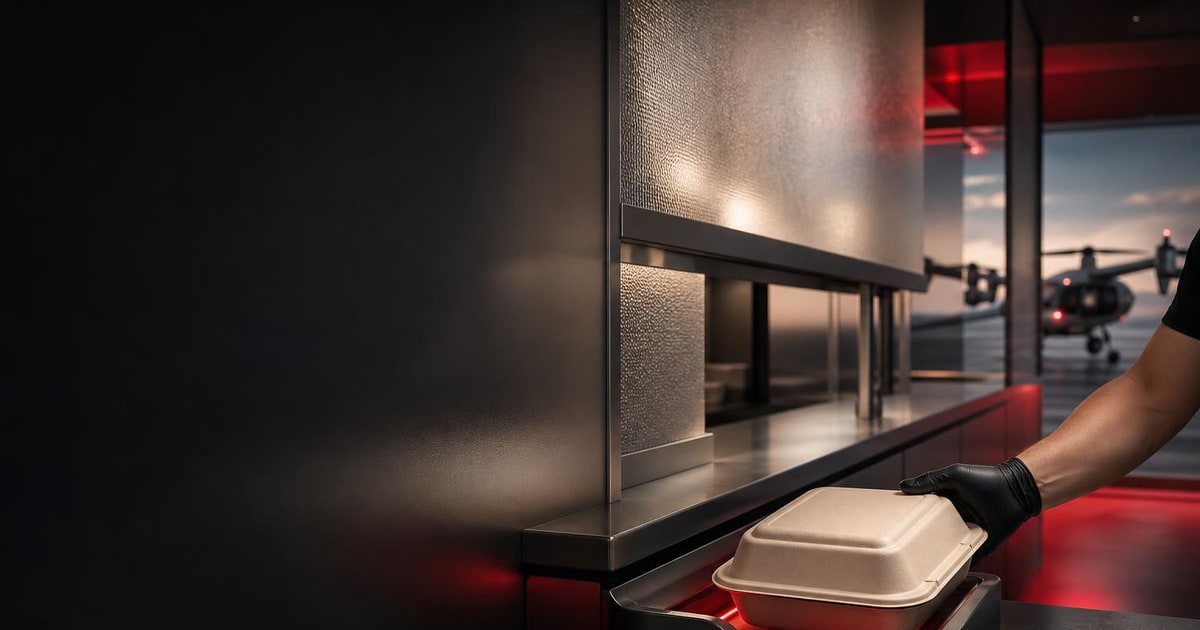
A sealed restaurant order is being placed into a loading cradle beside a restaurant pass counter.

How DoorDash Air Could Change UAE Restaurant Operations

A UAE restaurant should not read this as a signal to buy a drone. The nearer-term change is that delivery performance will depend more visibly on the quality of the order handoff between the front of house, kitchen, packaging station and delivery network.

DoorDash’s Autonomous Delivery Platform chooses between delivery modes order by order. It considers distance, weight, weather, flight range, ground traffic, kitchen preparation time and delivery timing. The same platform can coordinate human couriers, robots and drones rather than treating each mode as a separate operation. (about.doordash.com)

For a UAE operator, that points to four practical requirements:

This is where a restaurant POS becomes relevant. A system that puts delivery orders into the same operational queue as walk-in and takeaway orders gives the kitchen one place to work from. A restaurant POS with kitchen display, recipe-level inventory and delivery integration is not drone infrastructure, but it addresses the same weakness DoorDash is designing around: unreliable information at the point where food leaves the business.

The UAE-specific opportunity is therefore operational rather than aerodynamic. If a restaurant cannot say when an order will be ready, what packaging it needs, or whether the correct item has reached the dispatch point, a faster delivery vehicle will not solve the underlying problem. That is an inference from DoorDash’s description of its system, not a claim that DoorDash Air is available in the UAE. (about.doordash.com)

  • —One reliable order record from sale to dispatch
  • —Accurate preparation times by station or menu item
  • —Packaging rules linked to the order type
  • —A clear handoff point that staff can use repeatedly
Dubai Restaurant Delivery Handoff Example

Imagine a Dubai restaurant with delivery, takeaway and dine-in orders arriving together. Today, a delivery order may sit on an aggregator tablet, the kitchen may receive a printed ticket, and the packing team may rely on a verbal call when the food is ready.

A drone-ready version of that workflow would not begin with a landing area. It would begin by recording the order in one system, assigning preparation steps, marking the order as packed, confirming weight and packaging, and recording the exact handoff time. The delivery platform could then decide whether the order suits a courier, robot or aircraft when such options exist.

A connected ERP and automation setup becomes useful when the restaurant has several branches, separate stock records or manual reconciliation between orders and deliveries. For a single outlet with modest order volume, that may be unnecessary. A well-configured POS and disciplined kitchen process may be enough.

UAE Restaurant Delivery Handoff Readiness Check

The sensible step is a short readiness check, not a drone project. Review the last week of delivery orders and ask:

If the answers are weak, fix the order and handoff data first. If the answers are already strong, document the process and watch for delivery platforms or regulators to define what drone operations look like locally. DoorDash’s announcement describes an early-stage pilot in Northern California, not a UAE launch or a timetable for local availability. (about.doordash.com)

DoorDash’s own announcement is the right place to follow the product’s progress, but it should be read with its stated limits: the delivery-time and order-size figures come from selected US conditions, and the company identifies the announcement’s availability and performance statements as forward-looking. (about.doordash.com)

  • —Can the team identify the exact time an order was ready?
  • —Are delivery and walk-in orders visible in one queue?
  • —Does packaging change by meal, temperature or travel distance?
  • —Can the business explain a late handoff from its records?
  • —Would another delivery mode fit the order without changing the kitchen process?

Paknology Restaurant POS and ERP Fit

Paknology has a commercial interest where this conversation leads to restaurant POS, ERP or automation work. A cheaper or simpler option may serve a small UAE restaurant better if it only needs a reliable order queue, kitchen display and basic delivery reconciliation. The right next step is to map the handoff before choosing new software; if the problem is in restaurant operations, start with the Restaurant POS service and scope only what the outlet can use.

Ready to launch, automate and scale?

Book a free consultation and get a clear roadmap — from company formation to a fully automated digital operation.