Technology2026-10-215 min read

Gideon TREY for UAE 3PLs: Dock Automation Tests

Gideon has made TREY commercially available in North America, an autonomous forklift built for trailer loading and unloading. Here is what UAE warehouse and 3PL operators should test before treating it as a local investment.

Gideon TREY for UAE 3PLs: Dock Automation Tests

Gideon TREY UAE availability and buying decision

Gideon TREY is a serious dock-automation product, but the announcement does not establish UAE availability, local support or a buying price. A UAE operator should treat it as a technology to qualify, not an order to place. The sensible first step is to measure trailer volume, pallet patterns, dock congestion and WMS readiness against the product's stated operating range. (gideon.ai)

The useful question is not whether a forklift can drive itself. It is whether it can finish the trailer cycle when the load is untidy, the dock is busy and the last pallet is still inside.

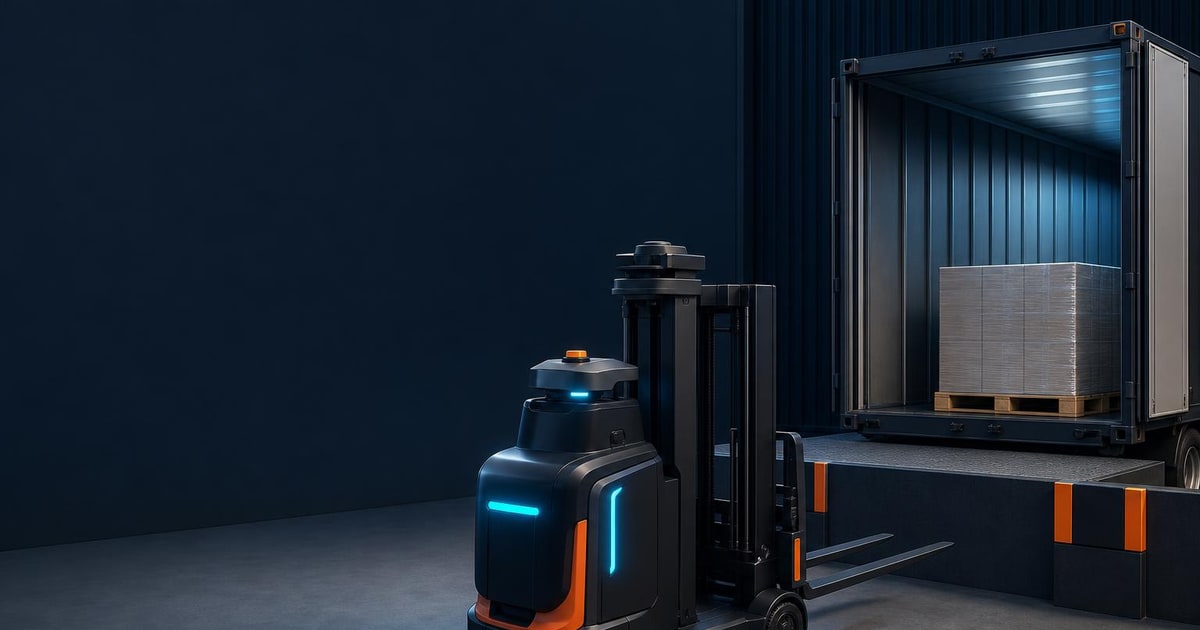
An autonomous forklift pauses at a warehouse dock with its forks aligned to a pallet inside an open trailer.

Gideon TREY trailer loading throughput and payload

TREY is an autonomous mobile robot forklift for loading and unloading trailers. Gideon says it can work from the first pallet to the last and is commercially available across North America, with deployments in automotive manufacturing, food and beverage distribution and 3PL operations. The announcement describes medium-duty and heavy-duty models rather than a single machine for every site. (gideon.ai)

The headline figures are useful for screening a UAE operation:

Gideon says the system is designed to perform best on loading docks handling 30 or more trailers per day. That is not a promise that every UAE site above that threshold will achieve a return. It is a useful point at which to start a structured review. (gideon.ai)

  • —Up to 28 single- or double-stacked pallets or cages per hour
  • —Up to 224 pallets or cages across an eight-hour shift
  • —More than 119 load-carrier types recognised
  • —Dry van, refrigerated, drop-deck and intermodal trailers supported
  • —Heavy-duty payload of 6,000 pounds with up to 10 hours of operation
  • —Medium-duty payload of 3,500 pounds with up to 12 hours of operation

Four-step UAE dock automation test

A warehouse owner should not begin with a robot demonstration. Begin with the operating data that will decide whether the robot has enough work to do.

Then build one worked case. Suppose a 3PL handles 30 trailers a day and the busiest eight-hour shift contains 180 pallet movements. TREY's published ceiling of 224 pallets per eight-hour shift suggests that the throughput may be relevant. It does not prove that the robot will achieve it. The real test is whether trailer variability, staging space, safety exclusions and associate interventions reduce the usable rate. (gideon.ai)

Ask the supplier to demonstrate the exact loads that cause delays today. That should include mixed orientations, dunnage inside the trailer, people and equipment near the travel path, and a staging area shared with manual forklifts. Gideon says TREY can recognise different pallet orientations, detect dunnage, pause for an associate and continue in a congested staging area. Those are the features that matter more than a clean showroom run. (gideon.ai)

  • —Count inbound and outbound trailers by day, shift and dock door
  • —Record pallet dimensions, weights, stacking patterns and damaged loads
  • —Mark every manual intervention, including dunnage removal and blocked staging lanes
  • —Confirm whether the current WMS or WES can exchange work instructions and completion data

UAE deployment requirements for autonomous forklifts

The main change is operational, not simply headcount. A successful deployment would move part of the dock job from continuous driving to exception handling, supervision and flow control. Associates may still need to remove dunnage, confirm that the area is ready and deal with loads outside the configured pattern.

TREY uses two stereoscopic cameras for image-based perception, two laser scanners for a 360-degree safety field and an embedded safety controller that can stop the vehicle. Gideon also says the system complies with ANSI/ITSDF B56.5-2019 and ISO 3691-4:2023. A UAE buyer should still ask for site-specific risk assessment, operator training, emergency procedures and local compliance review before deployment. (gideon.ai)

The announcement says no expensive changes to the facility, dock or trailers are required. That does not mean there is no implementation work. WMS or WES integration, network coverage, charging arrangements, traffic rules, maintenance and staff acceptance still need to be scoped. TREY includes fleet-management software and an analytics dashboard, and can operate with a WMS, WES or as a standalone system. (gideon.ai)
When process redesign beats a forklift robot

If your site handles a modest number of trailers, has predictable loads or still loses time because inventory and work instructions are spread across disconnected systems, a forklift robot may be the wrong first project. Fixing the process and data layer can be simpler. Paknology's ERP and automation service covers inventory, warehouse workflows, audit trails and integrations, while its ERP guide for small UAE retailers sets out the practical tests for choosing software without buying unnecessary modules.

There is also a hard commercial limit: Gideon's announcement covers commercial availability across North America, not a UAE sales channel, price, installation timetable or support model. Until those points are confirmed, a UAE owner should not put TREY into a capital budget as if it were a locally available product. (gideon.ai)

TREY assessment and ERP automation options

Paknology has a commercial interest in the ERP and automation work discussed here. It does not sell autonomous forklifts. A warehouse with a genuine high-volume dock problem should seek a direct TREY assessment and compare the full deployment scope; a smaller or less standard operation may be better served by process redesign, clearer warehouse data and simpler automation first. Before speaking to any supplier, prepare trailer counts, pallet profiles, intervention logs and WMS details, then talk to us if the information layer needs organising.

Ready to launch, automate and scale?

Book a free consultation and get a clear roadmap — from company formation to a fully automated digital operation.