Technology2026-10-315 min read

75 Driverless Trucks: The UAE Logistics Lesson

Kodiak’s first public-highway deal is not a UAE deployment. It is an early commercial test of driver-as-a-service, with useful lessons for local freight, warehouse and delivery planning.

75 Driverless Trucks: The UAE Logistics Lesson

What Kodiak’s 75-truck deal actually covers

Kodiak AI has signed an agreement with California freight carrier DTL Transport to deploy 75 driverless trucks on public highways. DTL will own and operate the trucks, while Kodiak supplies its autonomous driving system and charges by the mile under a driver-as-a-service model. The first planned routes are Interstate 10 between Dallas and El Paso, and Interstate 20 between Dallas and Atlanta. Kodiak’s announcement describes the agreement as the first publicly announced binding commitment by an interstate trucking company to operate driverless trucks in its own fleet. (kodiak.ai)

This is different from a technology company running the whole transport service. In the driver-as-a-service model, the carrier keeps the trucks, freight relationships and operating responsibility. The autonomy supplier provides the driving system as a service. That gives a fleet operator a route to use the technology without becoming a robotics company.

The agreement follows a California pilot in which Kodiak and DTL moved perishable goods for about 225 miles between Fresno and Los Angeles. A human safety operator remained behind the wheel during that work. Kodiak says it plans to begin driverless highway service in Texas by the end of 2026, subject to its safety and operating milestones. (kodiak.ai)

The important commercial shift is not simply “a truck without a driver”. It is a carrier buying driving capability as an operating service.

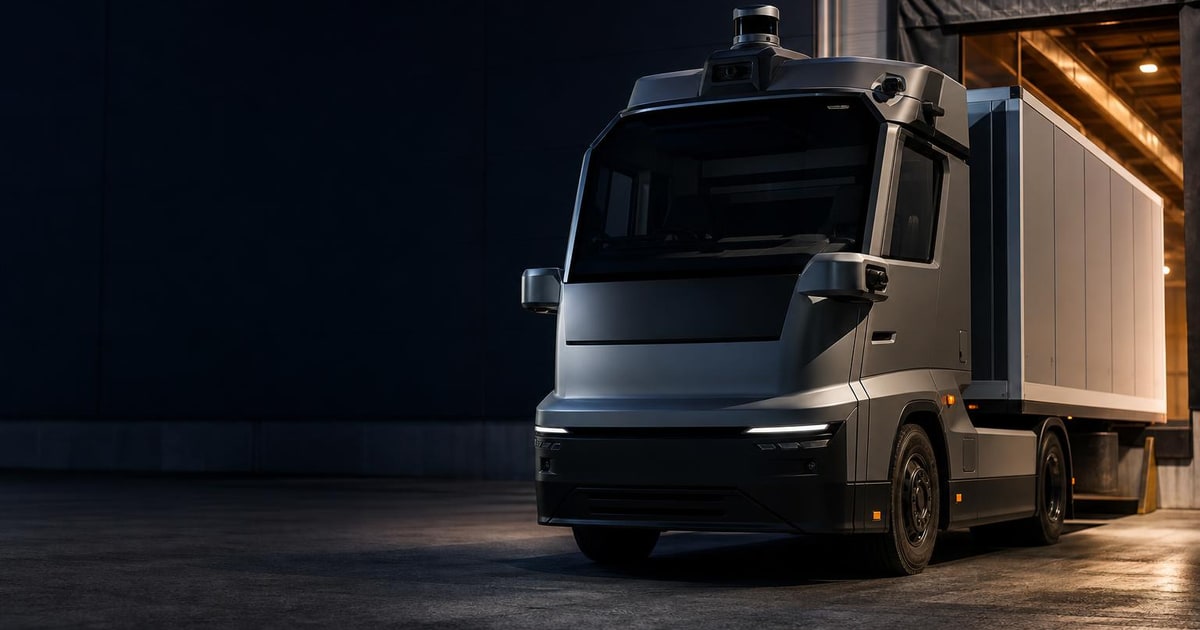
An unbranded driverless freight truck waits at a warehouse loading bay with its empty cab visible.

What Kodiak’s US deal means for UAE logistics

There is no UAE deployment in this announcement. The routes are in the United States, and the regulatory, road and insurance conditions are not the same as those facing operators here. A UAE fleet owner should therefore treat the deal as a signal about the direction of freight technology, not as a local purchasing opportunity.

The first likely lesson concerns how delivery costs are measured. Today, a transport manager usually thinks in terms of vehicles, drivers, fuel, maintenance, shifts and route productivity. A mature autonomous model would add a technology charge linked to miles or operating activity. That could make long, predictable highway movements more suitable for automation than short urban deliveries with frequent stops, loading changes and difficult handovers.

For a UAE distributor, that points towards a narrower question: which part of the journey is repetitive enough to standardise? A trunk movement between a central warehouse and a regional depot is a more obvious candidate than a driver taking mixed orders to many shops. The same logic could eventually apply to port-to-warehouse movements, scheduled replenishment and overnight line-haul work, subject to UAE rules and approved operating zones.

The operational dependency is data. Before a business can assess autonomous freight, it needs reliable records of route distance, delivery windows, dwell time, failed drops, vehicle utilisation and the cost of exceptions. A fleet that cannot explain why a route was late will struggle to compare a technology service with its current operation. That is where [ERP and automation support]( /services/erp-automation) becomes relevant: not because an ERP makes a truck autonomous, but because it can help establish a usable baseline.

Warehouse design matters as well. Autonomous line-haul only creates value if loading, unloading and handover processes do not add the time that the driving system saves. UAE operators reviewing warehouse automation can use the same discipline described in [our article on Exotec Skypod]( /insights/exotec-skypod-what-10x-faster-picking-means-in-the-uae): measure the whole flow, rather than celebrating one faster machine.
What the 75-truck deal’s numbers show

Kodiak has not disclosed the value of the DTL contract. The public announcement says DTL will pay a per-mile fee, but it does not publish the fee, minimum mileage, service-level terms, maintenance arrangement or delivery schedule. That means a UAE owner should not build a business case from a headline estimate.

The useful numbers are operational. The agreement covers 75 trucks. The planned work uses two interstate corridors. The earlier California pilot covered about 225 miles and still used a human safety operator. Those details show a staged commercial path: test a defined lane, prove the service, then move towards customer-owned fleet deployment.

A UAE operator could copy that method without buying new technology. Start with one lane and collect a month of dependable data. Record loaded miles, empty miles, waiting time, driver hours, fuel, maintenance, claims and failed delivery attempts. Then compare the present cost of that lane with any future technology proposal. If the route changes every week, the data will also show that automation may be a poor fit.

For businesses already trying to connect sales, stock and delivery records, [an affordable ERP for a small UAE retail business]( /answers/affordable-erp-small-retail-uae) may be a more immediate improvement than tracking autonomous-truck announcements.

What a sensible owner does

The sensible response is usually not to order driverless trucks. It is to make the business legible enough to judge them later. A logistics owner should identify the two or three most repetitive routes, establish their true cost, and check whether warehouse handovers and delivery exceptions are recorded consistently.

It is also sensible to ask suppliers precise questions when autonomous freight becomes available: who owns the vehicle, who carries insurance responsibility, what happens after a technology fault, whether the fee is per mile or tied to a minimum commitment, and which roads and weather conditions are supported. The Kodiak announcement answers none of those commercial questions for the UAE.

If your immediate problem is unreliable stock, fragmented dispatch data or weak route reporting, improve that first. Paknology has a commercial interest where [ERP and automation work]( /services/erp-automation) fits that need. If your fleet is small, your routes are irregular or your records are already clear, a spreadsheet and a competent transport manager may be the cheaper and simpler option. For now, the practical next step is to document one repeatable route well enough to compare future options honestly.

Ready to launch, automate and scale?

Book a free consultation and get a clear roadmap — from company formation to a fully automated digital operation.