Technology2026-09-145 min read

Ultrahuman’s AI Smart Ring Move: What UAE Businesses Should Do

Qualcomm’s investment signals a shift from smart rings as health trackers to software platforms. UAE retailers and wellness businesses should watch closely, but most should not invest yet.

Ultrahuman’s AI Smart Ring Move: What UAE Businesses Should Do

What Should UAE Businesses Do About AI Smart Rings?

Watch this category, but do not build a customer proposition around it yet. Ultrahuman is moving its smart rings beyond sleep, movement and health tracking towards on-device software, AI interaction and developer features. That creates possible use cases for UAE retailers, gyms, clinics and wellness businesses, but the commercial layer is still early.

On 3 September 2026, Ultrahuman announced a $70 million funding round that included Qualcomm Ventures, Labcorp and other investors. TechCrunch reported that the round valued the Bengaluru-based company at $365 million. The investment is a signal that major technology companies see smart rings as more than passive health trackers.

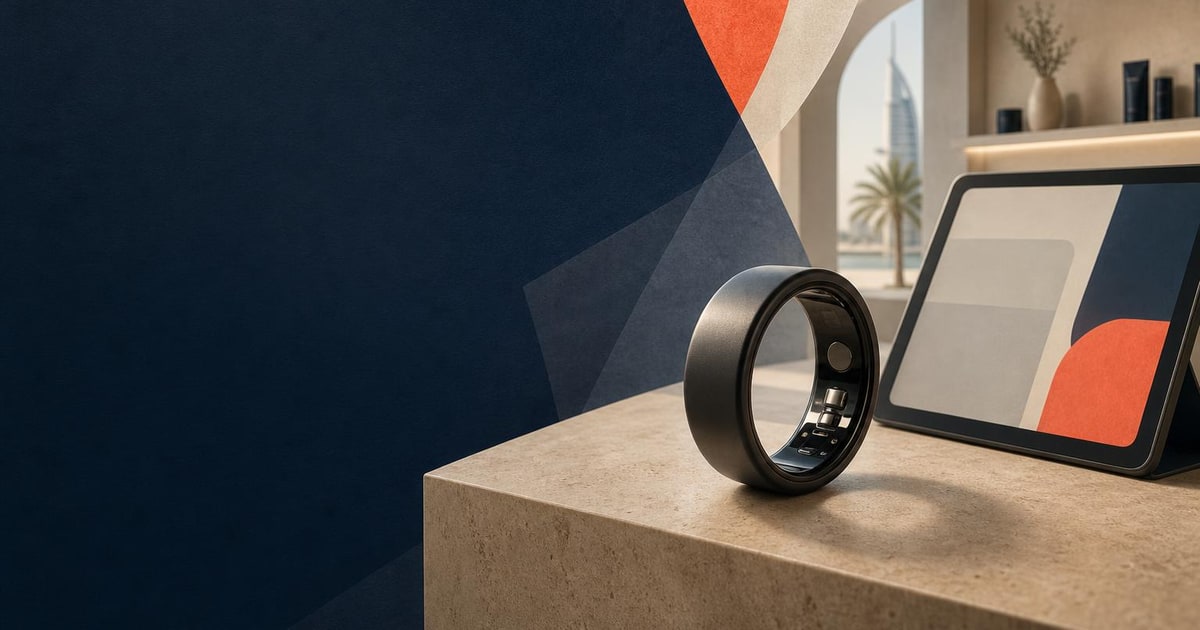
A smart ring sits on a wellness retail counter in front of a tablet showing abstract software panels.

What Has Changed in Ultrahuman’s Smart Ring?

The important change is not simply the funding. It is the direction of the product.

Ultrahuman says it is building a human-computer interface around continuous body signals. Its Ring platform combines wearable data with software, AI, blood testing, glucose monitoring and environmental sensing. The company describes the ambition as a computing platform that understands the user rather than another dashboard of readings.

TechCrunch reported that Ultrahuman is working with Qualcomm on a future ring using Qualcomm silicon. The company currently uses Nordic Semiconductor chips and expects to continue using both technologies. Ultrahuman says the additional computing capability should allow more software and algorithms to run on the ring, reducing reliance on a phone or cloud service.

That matters because the ring could become an input device as well as a sensor. Proposed applications include a pointer or mouse, a game controller, a car key and an interface for interacting with AI applications. These are announced directions, not established commercial features.

The near-term opportunity is observation, not a rushed hardware rollout.

Why Ultrahuman’s Smart Ring Software Matters More Than Hardware

Ultrahuman is trying to make the hardware more extensible after purchase. Its PowerPlugs add specialised health capabilities. Its UltraSignal platform gives developers access to sensor streams from the Ring AIR, including photoplethysmography, temperature and accelerometer data, so they can develop algorithms and health experiences.

The company also says Ring PRO moves more computation onto the wearable through on-chip machine learning and additional storage. Its Jade AI product is described as a real-time biointelligence platform that connects the wider health ecosystem.

For a UAE business, this points to a platform question. The value may not sit in selling the ring itself. It may sit in what happens when body data, personalisation and context can influence a service in real time.

Possible examples include a wellness programme that adapts recommendations to recovery signals, a fitness experience that responds to exertion, or a loyalty journey that uses opt-in health goals. A retailer might eventually use wearable-led interactions to make product discovery more personal. A hotel, gym or clinic could explore ambient services that reduce the need for a phone screen.

Those examples are possibilities, not claims that Ultrahuman currently supports each use case. Businesses should avoid presenting them as ready-made integrations.
Why UAE Businesses Should Watch Smart Rings

TechCrunch reported that Ultrahuman plans to deepen its presence in markets including India and the UAE, where physical stores and other offline touchpoints have helped drive sales. That makes the development more relevant locally than a funding announcement with no stated regional ambition.

The UAE has a strong retail, fitness, hospitality and private healthcare ecosystem. It is also a market where premium consumer technology often reaches physical stores, events and brand partnerships quickly. If smart rings become a recognised interface for AI and wellness services, local businesses may need to understand the platform before deciding whether to partner, stock products or build software around it.

The main business risks are data, consent and proof. Physiological information is more sensitive than ordinary loyalty data. A business would need a clear reason to collect or use it, transparent consent, secure handling and a careful boundary between wellness guidance and medical advice. The hardware also needs to be available, supported in the UAE and useful enough to justify staff training and customer education.

If your business is still managing customer data across disconnected systems, first review the basics. An ERP and automation setup may create more value than an experimental wearable integration. Retailers considering a new digital sales channel should also look at ecommerce onboarding for Amazon.ae and Noon before investing in a new interface.

Should UAE Businesses Invest in Smart Rings Now?

For most readers, the honest answer is not yet.

Do not buy inventory, promise AI-controlled experiences or commission a custom integration solely because Qualcomm has invested. The announced features are still developing. TechCrunch reported that some new capabilities for existing Ring AIR and Ring PRO devices were expected through a software update by the end of September 2026, including game-controller functions, interaction with AI applications and third-party feature development. As of 12 September 2026, that deadline has not passed, so businesses should wait for evidence that the features work, are available in the UAE and have usable commercial tools around them.

A small number of businesses can act earlier. A wellness brand, gym group or technology retailer with a suitable audience could run a limited discovery project. The work should focus on customer demand, consent, data governance and whether the experience improves retention or service quality. It should not assume that a smart ring automatically creates a new revenue stream.

Track four signals:

  • —UAE availability and support
  • —Confirmed developer access
  • —Consent and data controls
  • —Measured customer demand

What Can Paknology Help UAE Businesses With?

Paknology has a commercial interest where this decision exposes a wider digital need. We provide UAE company formation and trade licences, ecommerce launch, websites and mobile apps, ERP and automation through ZamBooks, restaurant POS, digital marketing and SEO, and WhatsApp Business API through Waphie. We do not provide smart-ring hardware or medical-product advice.

If your foundations are ready, our websites and mobile apps service could help with a controlled customer-facing pilot. If the simpler answer is better, use your existing app, website or WhatsApp workflow first and wait until wearable support is proven. That cheaper or simpler route is likely to serve most UAE businesses better for now.

The next step is to document one customer problem that a wearable might solve, then test whether it can be solved without one. If the answer is no, prepare a small pilot brief and speak to us about the relevant web and mobile app work.

Ready to launch, automate and scale?

Book a free consultation and get a clear roadmap — from company formation to a fully automated digital operation.