Technology2026-11-064 min read

UAE bulky-goods delivery: fewer missed visits

XPO’s proposed consumer delivery tools show how bulky-goods retailers can give customers better control over appointments, tracking and alerts. UAE businesses can copy the operating model without copying the whole platform.

UAE bulky-goods delivery: fewer missed visits

XPO’s proposed last-mile delivery tools for bulky goods

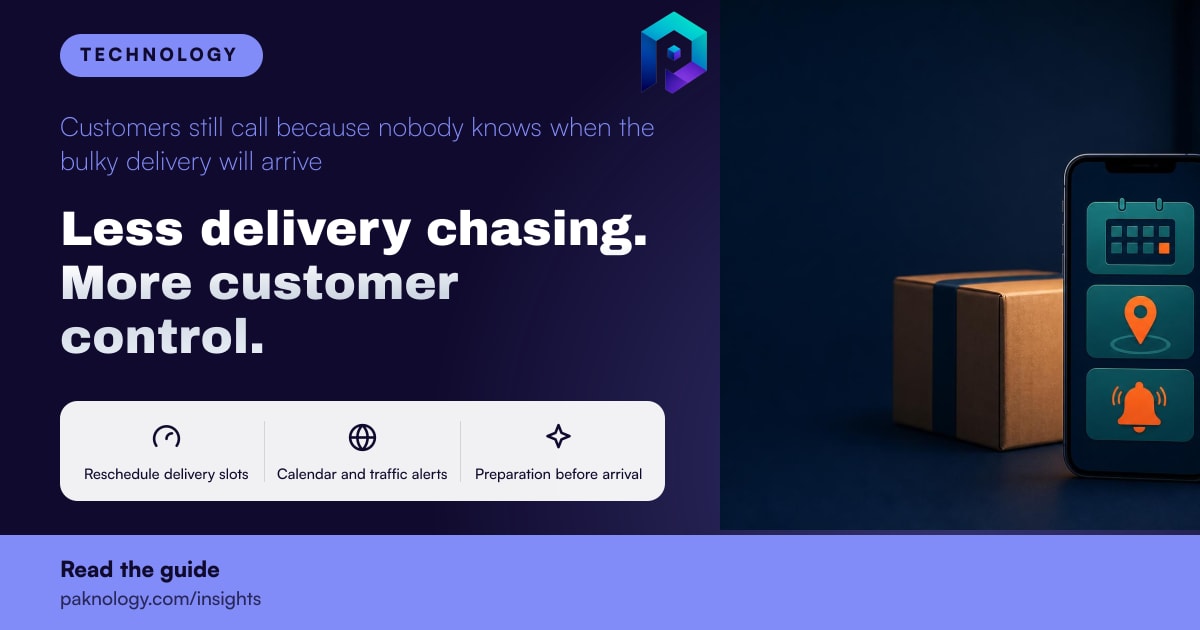
XPO announced a web-based last-mile system for heavy goods such as appliances and furniture. Its purpose is to give the customer more control after purchase, when delivery is harder than a normal parcel drop. The proposed tools include real-time order management, electronic rescheduling, calendar integration, weather and traffic alerts, and notifications by email, text message or voice. The announcement described an expected November launch in North America, followed by plans to adapt the technology for XPO’s European last-mile business. It did not announce a UAE rollout. XPO’s original announcement is therefore a useful operating example, not proof that the service is available here.

  • —The important idea is customer-controlled delivery, not simply a better tracking page.

For bulky goods, the delivery appointment is part of the product experience.

A customer holds a smartphone showing delivery controls beside a large wrapped parcel at an apartment doorway.

Why appointment control matters for UAE bulky-goods retailers

A UAE retailer selling sofas, beds, washing machines or large appliances has a different delivery problem from a seller shipping small parcels. Someone may need to be at home. The item may need to enter the property. The customer may need to clear a room, protect a floor or confirm that an installation team can work on the same visit.

XPO’s announcement says its existing last-mile experience included order-detail visibility, a preparation checklist, real-time tracking and ETA updates. The new layer adds more customer control around the appointment itself. That is the part a UAE business should study.

The potential benefit is fewer avoidable calls and fewer failed visits. That is an inference, not a result XPO quantified in the announcement. If a customer can change an appointment online, add it to a calendar and receive traffic or weather alerts, the retailer has a clearer chance of getting the delivery completed on the planned visit.

The scale of the problem is also visible in XPO’s own numbers. The company said it facilitated about 13 million carrier-based deliveries and installations a year in North America. That figure is not a UAE benchmark. It does show why a large operator would invest in self-service delivery management rather than rely on phone calls alone.

What UAE retailers can copy from XPO’s delivery model

Do not start by commissioning a full XPO-style platform. Start with the customer decisions that create the most operational work.

For example, suppose a furniture retailer has 30 bulky deliveries booked for a week. The first useful exercise is to record how many customers ask for a different slot, how many need a reminder, how many miss the appointment and how many calls are made simply to ask where the driver is. Those are the processes to redesign before choosing software.

A practical first version could include a delivery-status page, a clear appointment window, a preparation checklist, a rescheduling request and automated notifications. The system should pass changes to the warehouse, driver or installation team. A customer-facing page that does not update the operational team will only create another source of confusion.

A retailer with disconnected stock, sales and delivery records may need a wider systems review. Paknology’s ERP and automation service describes connected sales, inventory, reporting and workflow automation, with integrations for couriers and other tools where APIs are available. That is relevant when the delivery problem is really a data problem.

XPO’s customer-controlled delivery model versus phone and WhatsApp

The usual small-business approach is often a phone call, a WhatsApp message and a driver’s update. It can work when order volume is low and one person knows every delivery. It becomes fragile when orders come from several channels, customers change times frequently or installation is involved.

XPO’s model moves the customer from passive recipient to participant. The customer can manage the order, select notification preferences and respond to changes without waiting for an agent. The retailer gains a more structured record of what was agreed.

That does not mean every UAE retailer needs a custom app. A mobile-friendly website, a properly connected order system and disciplined notifications may be enough. Paknology’s websites and mobile apps service includes customer portals, dashboards and API integrations, but a project should be scoped around the delivery workflow rather than around a fashionable feature list.

How to reduce missed bulky-goods deliveries in the UAE

Map one week of bulky deliveries. Count rescheduling requests, missed appointments, status calls and installation problems. Then ask your courier or software provider which parts can already be handled through existing tools. If the process still breaks because sales, stock and delivery data sit apart, consider an ERP and automation assessment. If one branch has few bulky orders and the current process works, improving the checklist and notification routine may be the cheaper and simpler answer.

Paknology has a commercial interest where this review leads to an ERP, automation, website or customer-portal project. A cheaper or simpler option may serve you better when delivery volume is modest, your courier already provides usable tracking and staff can manage appointments reliably without a new system.

Ready to launch, automate and scale?

Book a free consultation and get a clear roadmap — from company formation to a fully automated digital operation.