Technology2026-10-095 min read

130 Autonomous Yard Trucks: Lessons for UAE Logistics

Venti says it will deploy more than 130 driver-out autonomous trucks across eight North American rail sites by 2027. UAE logistics operators should treat this as a yard-automation benchmark, not a reason to buy trucks immediately.

130 Autonomous Yard Trucks: Lessons for UAE Logistics

Venti’s 130 autonomous yard trucks for North American rail sites

Venti Technologies announced on 1 October 2026 that it plans to launch what it describes as the United States’ first driver-out autonomous truck fleet for an intermodal rail yard. The trucks are intended to load, move and unload containers inside live yard operations, working around cranes, trains, forklifts and human-driven traffic. Venti says the vehicles do not need dedicated lanes or changes to the terminal layout. The company’s announcement is based on a commercial agreement with a North American Class 1 railroad. (globenewswire.com)

The planned deployment is more than 130 autonomous container-moving trucks across eight railway sites by 2027. Venti also says the agreement could expand to more than 600 vehicles by the end of the decade. That makes this a scale announcement, not just a technology demonstration.

The important development is not a self-driving truck on a test track. It is driver-out movement inside a busy freight yard.

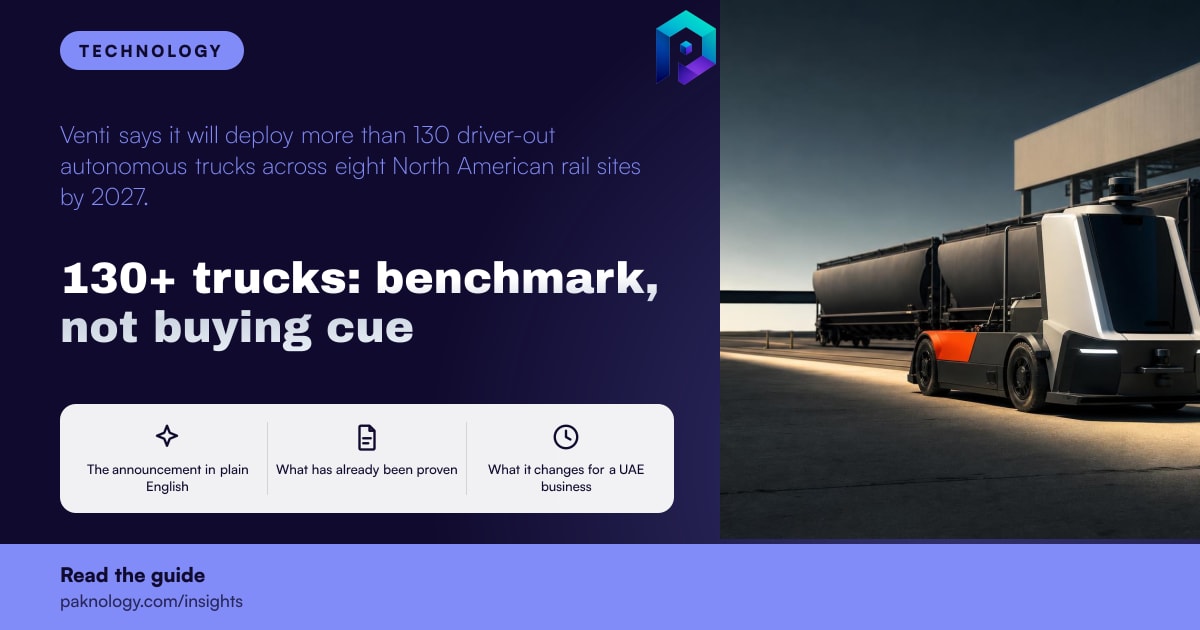
A single autonomous yard truck carries a container along a rail terminal lane beside parallel tracks and orderly container stacks.

Autonomous yard trucks: 500,000 miles and 360,000 containers

Venti says its trucks have operated in continuous commercial production at PSA Singapore for nearly three years. The fleet works around 1,200 human-driven trucks and has moved more than 360,000 containers. The company also reports more than 500,000 autonomous miles with no critical incidents. Those are company-reported figures, so an operator should still ask for customer references, incident definitions and operating data before treating them as a procurement case. (globenewswire.com)

The technology is designed to handle day and night operations, rain, snow and other poor weather. Trucks can be retrofitted or supplied as new vehicles. Venti says its vehicles make decisions and localise on board, and can drive and park to one-inch, or two-centimetre, positional accuracy.

For a UAE warehouse, port or third-party logistics operator, the useful question is narrower: does your yard contain repeatable trips between fixed points, enough volume to justify dedicated equipment, and a layout where vehicles spend time waiting, queuing or making the same movements?

What autonomous yard trucks mean for UAE logistics

The announcement changes the reference point for automation. Yard autonomy is moving from a controlled pilot towards continuous production in mixed environments. That does not mean a Dubai or Abu Dhabi operator can deploy the same system tomorrow. It does mean that automation discussions can now be based on measurable tasks rather than a general promise that artificial intelligence will improve logistics.

The strongest fit is likely to be a contained process: moving containers between a gate, storage block, loading area, rail interface or warehouse dock. A business should not start with the question, “Can we replace every driver?” It should start with, “Which movements are repetitive enough to measure and control?”

Venti says its technology can reduce transportation costs by 40% to 70% within logistics operations. That is a vendor claim, not a guaranteed UAE result. The real comparison would need to include vehicles, safety systems, integration, supervision, maintenance, insurance, site preparation and the cost of changing operating procedures. (globenewswire.com)

How UAE operators can prepare for yard automation

Most owners should not rush to purchase autonomous yard vehicles based on this announcement. They should prepare the information that would make a future decision possible.

Then test whether the problem is really vehicle autonomy. If the main issue is that stock, dispatches, purchase orders and warehouse activity sit in separate systems, a connected operational platform may create value before any autonomous truck is considered. Paknology’s ERP and automation service covers inventory, warehouse processes, reporting and workflow automation, with scope defined after process discovery rather than by selling every available module. (paknology.com)

  • —Map every yard movement for two or four weeks
  • —Record trip frequency, waiting time and failed handovers
  • —Separate driver time from loading and queuing time
  • —Mark areas where people and vehicles regularly cross
  • —Measure container or pallet moves by shift
  • —Document exceptions that require human judgement

Autonomous yard trucks versus conventional yard operations

A conventional yard depends on drivers, radio or mobile instructions, supervisors and a warehouse or transport system. That approach is flexible. People can deal with unusual loads, blocked routes and customer changes without waiting for a system rule to be rewritten. It is also familiar and may be the sensible choice for a small or irregular operation.

An autonomous yard vehicle is different. It needs a defined operating area, reliable task instructions, clear safety rules and a way to deal with exceptions. The gain is potentially more consistent movement and less dependence on a driver being available for every repeatable trip. The trade-off is that the business must make its processes more structured.

For smaller operators, the first investment may therefore be data discipline. Paknology’s guide to choosing an ERP for a small UAE business recommends testing stock transfers, returns, VAT reporting, simultaneous edits and audit trails using real transactions. The same principle applies in a yard: test the workflow with real movements before buying automation around it. (paknology.com)

Paknology’s role in ERP and yard automation

Paknology has a commercial interest in ERP and automation work. Its role is to help map processes, configure systems, migrate data and connect available tools. It does not supply autonomous trucks, and this article is not a recommendation to buy them.

A cheaper or simpler option may serve you better if your yard has low volume, irregular movements or weak operational data. In that case, improve the dispatch process, tighten location records and measure the work before considering a larger technology project.

How to assess a UAE yard for autonomous vehicles

Choose one repeatable yard process and measure it before discussing autonomy: volume, waiting time, labour input, exceptions and safety constraints. If the bottleneck is information rather than vehicles, review the ERP and automation option; if there is no clear fit, talk to us with the process data and we can say so.

Ready to launch, automate and scale?

Book a free consultation and get a clear roadmap — from company formation to a fully automated digital operation.